Best agentic marketing platforms for 2026 (ranked)
TL;DR: The best agentic marketing platform for scaling Meta and TikTok ads in 2026 depends on how much of the job you actually want a machine to own. If you want creative and media buying handled end to end, Superscale and the platform-native agents (Meta Advantage+, TikTok Smart+) are the closest things to a true autonomous operator. Enterprise teams running media at scale across many channels will get more from Smartly and Pixis, which lead on breadth. And if your problem is creative volume on a budget, Omneky, Madgicx, and AdCreative.ai do most of the work without owning the spend. Almost everything marketed as "agentic" in 2026 is really an ad maker, an optimization layer, or a genuine closed-loop agent. This list sorts them honestly.
That distinction matters because "agent" has been stretched to cover any product with a chatbot bolted on. A real agentic system doesn't just generate assets faster. It decides what to test, ships it into the ad account, reads the result, kills losers, and scales winners, on its own, inside guardrails you set. Most tools below do a slice of that loop well. A few do the whole thing, and the gap between those two groups is the most important thing to understand before you buy.
I build one of these systems, so treat this ranking as informed but interested. I've tried to earn your trust by conceding where competitors are genuinely better and by sourcing every price and capability claim to the vendor's own site or an independent review. Where I couldn't verify a number, I say so.
At a glance
What "agentic marketing" actually means (and what it doesn't)
Agentic marketing is the practice of handing a brand's performance-marketing work (research, creative production, testing, media buying, optimization) to an autonomous AI agent that works for the brand rather than as software a human operates. You set a goal and guardrails. The agent does the work and reports back. I unpack the full architecture in our guide to what agentic marketing is, but the short version is a loop: observe, reason, plan, act, learn.
That makes it different from the two categories it gets confused with constantly. AI marketing tools (Jasper, Copy.ai, HubSpot Breeze Assistant) are software humans drive. They speed up a task you were already doing, and they don't decide anything material. AI ad makers (AdCreative.ai, Creatify, Pencil) are generative creative factories. They produce assets fast, but they don't buy media and they don't pick what to test. AI marketing agents do the whole job and answer for the outcome, which means ROAS, CAC, or CPI rather than throughput.
A quick field test I give founders: if a pricing page lists seats, it's a tool. If it lists credits or generations, it's an ad maker. If it talks about outcomes, spend under management, or campaigns run on your behalf, it's an agent.
Most of the products below sit somewhere between ad maker and agent, and the honest reviews call out exactly where.
The market is moving this way fast. According to First Page Sage's 2026 agentic AI adoption report, marketing-campaign automation now sits at a 45% adoption rate among enterprise and mid-market deployments, with reported outcomes of 27% faster campaign builds and 19% lower cost per lead, though marketing still lags functions like customer service (68%) and supply chain (58%). The demand pressure is real.
Agentic AI adoption by function, 2026
Customer service   ████████████   68%
Supply chain       ██████████░░   58%
Marketing          ████████░░░░   45%
Source: First Page Sage 2026 agentic AI adoption report.
Marketing Brew reported in April 2026 that one agency client needed 1,000 creative assets across personas and concepts just to feed Meta's AI delivery engine. Producing that volume by hand is over. The only question is who produces it for you, and how much of the buying they also handle.
How the tools break down
Generate creative and run the media buy. Native agents (Meta Advantage+, TikTok Smart+) and independents like Superscale.
Quote-only, percentage-of-spend pricing across many channels. Smartly, Pixis.
Generate assets on demand; you take the files and run them. Madgicx, Omneky, AdCreative.ai.
How we evaluated these platforms
I ranked on the axes that decide whether a platform actually moves your cost per result, not on marketing copy. Six criteria, weighted toward autonomy and the paid-social use case (Meta and TikTok), because that's where agentic marketing is most mature and where most readers of this page spend.
- Autonomy. Does it close the loop, meaning generate, ship, read results, kill, scale, or does it hand a recommendation back to a human? This is the line between an agent and everything else.
- Creative depth. Can it produce ready-to-launch ads (video and static) in every aspect ratio a placement needs, on-brand, or does it produce raw clips you finish elsewhere?
- Media-buying integration. Is it API-connected to Meta and TikTok Ads Manager so it can actually act, or does it export files for a human to upload?
- Channel coverage. Paid social only, or paid social plus search, programmatic, CTV?
- Pricing transparency and accessibility. Public self-serve pricing that a founder or small team can buy, or enterprise quote-only?
- Honest fit. Who it's genuinely best for, and who should look elsewhere.
I verified every price and capability claim on each vendor's live site in June 2026, or against an independent listing where the vendor's own page was inaccessible. Where a number comes from a third party rather than the vendor, I flag it. Performance stats published by a vendor are labeled as vendor-reported. I did not invent a single figure.
One disclosure up front: I make Superscale, which appears on this list. I placed it where its real differentiation puts it, conceded where rivals win, and listed its limitations in the same detail as everyone else's. If that's not what you find below, I failed.
All 8 platforms at a glance
| Platform | Type | Pricing | Best for |
|---|---|---|---|
| Superscale | Autonomous agent | $49–$399 / mo | Paid-social creative-to-launch at agency volume |
| Meta Advantage+ | Platform-native agent | Free | Meta-concentrated spend |
| TikTok Smart+ | Platform-native agent | Free | TikTok-first brands |
| Smartly | Automation suite | Quote-only | Enterprise cross-channel scale |
| Pixis | Optimization layer | Custom / enterprise | Large consumer brands |
| Madgicx | Co-pilot | ~$49+ / mo | Meta-first buyers and small agencies |
| Omneky | Ad maker + launcher | ~$99 / mo | Affordable multi-channel creative |
| AdCreative.ai | Ad maker | ~$29–$999 / mo | Pure creative supply |
Pricing reflects June 2026 and, where noted, includes third-party or estimated figures. Verify on the vendor's live page before purchase.
The best agentic marketing platforms for 2026
1. Superscale: best for autonomous creative-to-launch on Meta and TikTok
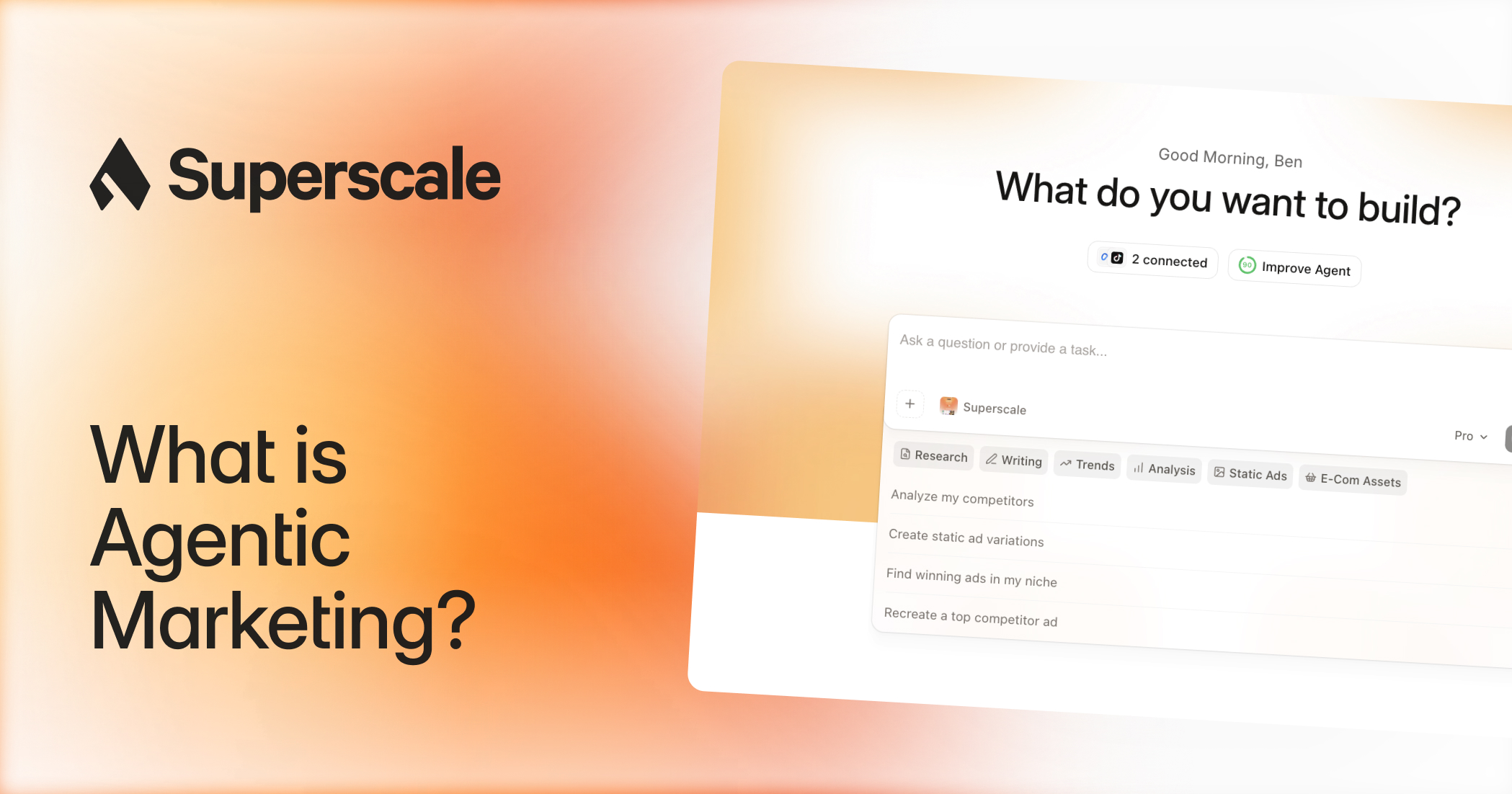
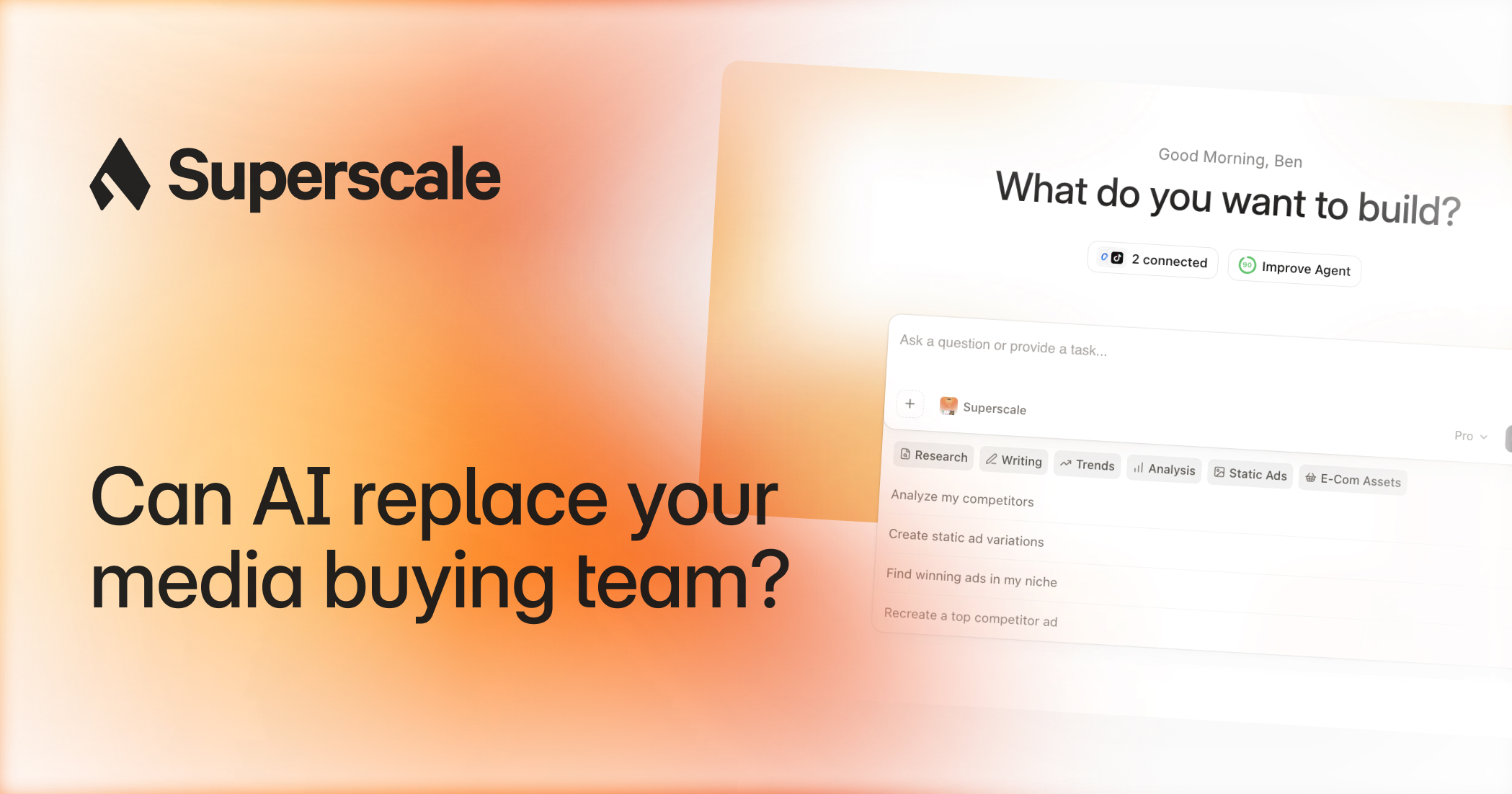
Where it shines. Superscale is the one platform on this list built specifically as an end-to-end "Ad Agent" for performance creative. You paste a link (a Shopify store, an App Store URL, a website) and the Agent imports your product and brand, researches what competitors are running in the Meta Ad Library, writes the scripts and copy, generates 10+ ready-to-launch ads in both video and static, resizes them to 9:16, 1:1, and 16:9, and pushes them straight to Meta, TikTok, Instagram, or Google Ads. Then it reads the account, iterates on winners, and flags or pauses underperformers. That's the full creative-to-launch loop in one workflow, which is rarer than the category's marketing implies. Our deeper walkthrough is in the autonomous media-buying explainer.
Key features. The Agent (one-prompt, end-to-end); AI UGC video with 300+ characters and 25+ languages with native accents; a built-in timeline editor with karaoke-style captions (the "CapCut built in"); a Competitor Ad Spy tool surfacing live competitor ads from the Meta library; brand analysis from a single URL; and multi-brand workspaces for agencies. Video runs on Seedance (15s Agent videos) with longer Speaking Character templates up to 120s.
Pricing. Free to start with 1,000 credits (no card; downloads locked until you activate the free 5-day trial). Paid plans run $49 (Starter), $99 (Advanced), $199 (Pro), and $399 (Scale) per month, with a custom enterprise tier above that. The detail that matters for media buyers is that ad-account integrations with Meta, TikTok, and Google require the Advanced plan ($99) or higher. They're not on Starter. All numbers from the live Superscale pricing.
Best for. Founders, performance marketers, and agencies who want agency-level creative volume on Meta and TikTok without agency cost, and who want the agent to handle production and launch rather than hand back files. Verified customers include Taxfix (+45% CTR, −20% CPA across 200+ ads), SumUp (120+ Meta ads across 8 languages), and Blinkist. HubSpot CMO Kipp Bodnar called it "the best autonomous AI marketing agent that we have seen so far."
Limitations. I'll be straight about these. Superscale's G2 review base is younger and smaller than incumbents like Smartly or Madgicx, so there's less third-party social proof to lean on. The channel set is concentrated on paid social plus Google UAC; it's not an omnichannel suite touching CTV, programmatic display, or LinkedIn the way enterprise platforms do. Agent video currently maxes at 15 seconds for the conversational path, and longer videos run through templates that don't apply full brand context. If you need one platform to run search, display, CTV, and social across a Fortune 500 budget, this isn't it. If you need a tireless creative-to-launch operator for paid social, it is.
2. Meta Advantage+ (with Andromeda): best platform-native agent, if you live inside Meta
Where it shines. Advantage+ is Meta's own AI ad automation suite, and in 2026 it's the closest thing to a closed loop that runs entirely inside Meta's machinery. The engine underneath is Andromeda, a retrieval system Meta described in December 2024 as a "10,000x increase in model complexity" over its predecessor, narrowing tens of millions of ad candidates down to a few thousand per user. The shift is toward creative-first delivery: Meta reads your creative and predicts who will respond rather than relying on advertiser-set audiences. Meta reported roughly +6% recall and +8% ads quality on selected segments from Andromeda, and Marketing Brew noted a 14% ad-quality improvement on Facebook from a Q3 update.
Key features. Automated audience expansion, budget optimization, placement selection, and increasingly generative creative variation, all inside Ads Manager. Mark Zuckerberg's stated vision, per Marketing Brew, is for advertising to become "as simple as inputting a credit card number and a business goal. AI will take care of the rest," a state Meta has suggested could arrive by end of 2026 (marketers are skeptical of that timeline).
Pricing. No platform fee. It's free tooling inside Ads Manager; you pay only for media.
Best for. Advertisers whose spend is concentrated on Meta and who are comfortable ceding control to the platform's own optimization. It's free, it's native, and it works.
Limitations. The agent works for Meta, not for you. It optimizes toward Meta's objectives and gives you limited visibility into why it made a choice. It's single-platform, with no cross-channel reasoning. Brand adoption of full automation stays cautious too: per Marketing Brew, control concerns and legal worry over undisclosed AI-generated imagery keep most advertisers with a hand on creative, even as Advantage+ reportedly makes up 60 to 70% of one major agency's Meta spend. You also still need to feed it good creative at volume, which is exactly the gap independent platforms fill.
3. TikTok Smart+ with Symphony: best native agent for TikTok-first brands
Where it shines. Smart+ is TikTok's automated campaign product, and Symphony is its generative-AI creative suite. In 2026 the two converged. Symphony Automation brings generative tools directly into Smart+, per TikTok's own announcement. The standout feature, Recommended Creatives, uses your campaign destination URL to generate a mix of video assets on the spot: it analyzes your page's products and pricing, auto-creates videos with scripts, voiceovers, and virtual avatars, and adds them during delivery to fight creative fatigue. Automatic Enhancements upscales, resizes, refreshes music, and translates and dubs videos in over 50 languages.
Key features. Module-level automation control, where you toggle targeting, budget, and placements between manual, hybrid, and fully automated, plus generative creative and a closed optimization loop similar in spirit to Meta's. TikTok published case results including Halara's 70% drop in CPA versus a control campaign using Recommended Creatives, and a 50% lower CPA for another advertiser via dubbed, localized content. Treat both as vendor-reported.
Pricing. No tool fee; built into TikTok Ads Manager. You pay media spend.
Best for. Brands whose growth motor is TikTok and who want native creative generation plus automated buying without leaving the platform.
Limitations. Same structural issue as Meta: it's platform-locked, the agent doesn't reason across channels, and it optimizes for TikTok's goals. Its generated avatars and voiceovers raise the same AI-disclosure questions. And the published stats are TikTok's own case studies, not independent benchmarks.
4. Smartly: best enterprise automation suite for cross-channel scale
Where it shines. Smartly (formerly Smartly.io) is the most mature media-management suite on this list and the broadest on channels. Its homepage pitch is unifying creative and media teams, and it genuinely does both: an AI Studio for producing and scaling creative across platforms, plus campaign launch, management, and optimization that the site describes as running "auto-magically." Channel coverage is the widest here, spanning social, Connected TV across 200+ streaming services, open web and DSPs, and video.
Key features. Creative production at scale, programmatic and social buying, cross-channel measurement (Brand Pulse), and template-driven creative personalization. This is the platform a large in-house team or holding-company agency reaches for when they're running serious budget across many channels at once.
Pricing. No public pricing. It's quote-based and sales-led. Smartly's own pricing URL returns a 404, and Capterra lists it as "Contact vendor" with no free trial. Third-party analysts estimate roughly 2 to 4% of managed ad spend plus a monthly minimum (often $2,000+) and onboarding fees, effectively targeting advertisers spending $50K+/month. Those are reseller estimates, not Smartly's published rates, so treat them as directional only.
Best for. Enterprise and mid-market teams with large, multi-channel budgets and the headcount to run a powerful suite. It rates 4.5/5 on Capterra (13 reviews).
Limitations. It's enterprise-only. Opaque pricing, onboarding fees, and a spend floor put it out of reach for founders and small teams. And it matters for this list that Smartly is heavy automation with a human in the loop, not a fully autonomous closed-loop agent. The site stops short of claiming an agent that buys, optimizes, and re-creates without oversight, because that's not what it is. Call it a strong automation suite trending toward agentic.
5. Pixis: best AI optimization layer for large consumer brands
Where it shines. Pixis positions itself as "a complete, AI-powered advertising solution helping consumer brands improve ad performance and streamline workflows," with the tagline "where creativity meets performance" on its homepage. It's built around three products: Adroom for creative, Prism as a campaign-performance command center, and Visibility for AI-search presence tracking. The pitch, per its G2 listing, is "tailor-made, true AI for their brand (not rules-based)," an optimization layer trained on, per Pixis, more than 3 billion data points that allocates budget, targets audiences, and optimizes campaigns in real time.
Key features. On-brand creative generation, real-time bid and budget optimization, audience targeting, and creative-asset management with set-and-forget automation. Pixis raised $85M as a full-stack platform and counts large brands like DHL, Sanofi, HelloFresh, and Allbirds among 200+ customers.
Pricing. No pricing published on Pixis's own site; it's enterprise, contact-sales. A third-party aggregator lists Prism starting around $200/month with a 14-day trial, but that's unverified against Pixis directly, so don't bank on it.
Best for. Larger consumer brands that already run significant spend and want an AI layer to optimize performance and creative across it. It rates 4.6/5 on G2 (14 reviews).
Limitations. Pixis is an optimization and AI-assist layer, not a self-described autonomous end-to-end agent. Its own copy stays at "AI command center" and "AI sidekick." Pricing is opaque and aimed at enterprise, so founders and small teams will find it inaccessible. The G2 review base is small.
6. Madgicx: best agent-style co-pilot for Meta-focused buyers
Where it shines. Madgicx is the most agent-forward of the budget-accessible Meta tools. Its homepage pitches "the secret AI Ads Manager top ad agencies use to run all accounts," and its AI Marketer is described as working "like your personal AI Ad Agency… to audit your account, identify opportunities, and tell you exactly what to do next." Note the verb: tell you what to do next. That's recommendation-led, not unattended execution. Madgicx does ship genuinely autonomous sub-components, though, including an AI Ads Generator, an automated Ad Launch tool, and an "Ads Rotation Agent" that swaps creative on its own.
Key features. Meta Ad Creative Optimizer for instant creative generation, automated ad launching, a "Personal AI Media Buyer" with Facebook ads automation, audience insights, and creative performance analysis. Strong on Meta, with Google support.
Pricing. Madgicx doesn't publish tier dollar amounts; its pricing page shows "see price inside the app," scaled to your monthly ad-spend bracket, with a 7-day free trial and a Tracking Pro add-on at $49/month per account. Third-party sources cite an entry point near $49/month scaling past $499/month for agency use, but those aren't vendor-confirmed.
Best for. Meta-first performance marketers and small agencies who want a powerful, affordable co-pilot with some autonomous components. It rates 4.6/5 on G2 across 212 reviews, the deepest review base of any independent platform here.
Limitations. The flagship AI Marketer recommends; it doesn't fully own execution. Channel scope is primarily Meta plus Google, not omnichannel. Pricing is gated behind an app login with no transparent public tiers, and its Capterra rating (around 4.0/5) runs notably below its G2 score, which points to an uneven experience for some users.
7. Omneky: best for affordable multi-channel creative generation
Where it shines. Omneky is a creative-generation-led platform with something rare in this group: public, low-cost, self-serve pricing. Its homepage describes it as an "AI-powered creative platform that generates high-performing image, video, and UGC ads in seconds and launches them across Meta, Google, TikTok, LinkedIn, and Reddit with real-time performance insights." It generates hundreds of on-brand variations from a single brief, turns product images into video ads, and analyzes creative performance with computer vision.
Key features. Multi-channel creative generation and launch, computer-vision performance tagging, and omnichannel campaign flow across five paid platforms from one place.
Pricing. Public and accessible: a Standard plan around $99/month (or ~$79 billed annually) for one brand and ad account per platform, with a 7-day free trial and an enterprise tier on request. A third-party listing shows a lower starting price, so the exact entry point isn't fully reconciled. Verify on Omneky's pricing page before you commit.
Best for. SMB-to-mid-market teams who want high creative volume across several paid channels without enterprise pricing.
Limitations. Omneky is best understood as an AI ad maker plus multi-channel launcher with analytics, not a fully autonomous closed-loop agent. Its site doesn't document an agent that re-allocates budget or iterates creative without human approval. A common reviewer critique is that generated outputs can feel generic and need adjustment. The public review base is also thin and inconsistent across sources.
8. AdCreative.ai: best pure creative engine to feed the agents above
Where it shines. AdCreative.ai is the most established pure ad-creative generator, self-described as "the #1 most used AI tool for advertising" on its homepage. It generates ad banners, copy, product photoshoots, and videos, and layers on a Creative Scoring AI that claims over 90% accuracy at predicting which creative will perform, plus competitor insights, a compliance checker, and "Instant Ads" from a URL.
Key features. Banner and creative generation, video and UGC ads, AI product photography, ad-copy generation, and predictive creative scoring.
Pricing. Tiered and segment-priced. Reported plans cluster from a Startup tier around $29/month up through Professional tiers in the ~$189 to $399 range and Ultimate/enterprise tiers up to ~$999/month, with a 7-day trial. Prices vary across Capterra and other listings, and the live pricing page was inaccessible at time of writing, so confirm current numbers directly before buying.
Best for. Teams that want a high-quality creative supply engine to feed into Meta, TikTok, or one of the agents above. Pair it with a platform that actually buys media.
Limitations. This is the clearest case on the list of "not agentic." AdCreative.ai produces and scores creative but doesn't buy, run, or optimize campaigns. You export assets and deploy them yourself, or let Meta's and TikTok's native automation run them. It's a production tool, not a campaign agent. Useful, but only the front half of the loop.
How to choose the right agentic marketing platform
Start with the honest question: how much of the job do you actually want to give away?
If you want an autonomous operator for paid social, meaning something that researches, builds, launches, and iterates creative without you in the weeds, you're choosing between an independent agent (Superscale) and the platform-native agents (Meta Advantage+, TikTok Smart+). The trade-off is whose side the agent is on. The platform agents are free and excellent inside their own walls, but they optimize for Meta's and TikTok's revenue and they don't reason across channels. An independent agent works for you, runs across Meta and TikTok together, and gives you control over creative and brand. If your spend is 90% on one platform and you trust that platform, native is hard to beat on price. If you run both channels and care about creative ownership, independent wins.
If you're an enterprise with a large multi-channel budget, the breadth of Smartly or the optimization depth of Pixis matters more than full autonomy. You have the headcount to run a powerful suite, and you need channels the paid-social agents don't touch: CTV, DSP, programmatic. Accept the quote-based pricing and the human-in-the-loop reality. I'd be doing you a disservice to point you at a paid-social agent for a Fortune 500 omnichannel media plan.
If your binding constraint is creative volume on a budget, Madgicx, Omneky, or AdCreative.ai get you most of the way for under $200/month. Just be clear-eyed that you'll still own the buying decisions, or hand them to the platforms' native automation.
If you're a DTC brand or consumer app, creative volume and iteration speed are your tightest constraints, and the channel set is concentrated on Meta and TikTok. That's the sweet spot for an autonomous creative-to-launch agent. We wrote a vertical-specific playbook for DTC ecommerce that goes deeper than this list can.
A useful gut check before you sign anything: ask the vendor to walk you through what happens after a creative is launched. If the answer is "you review the report and decide what to do," you've got a tool or a co-pilot. If the answer is "the agent kills the bottom performers and scales the winners on its own, inside your limits," you've got an agent. Both are legitimate purchases. They're just not the same purchase.
What actually changed in 2026
Three things changed this year that don't fit neatly into a vendor pitch.
First, the platforms got serious. A year ago you could draw a clean line between "the algorithm" and "your creative." Meta's Andromeda and TikTok's Symphony erased it. Delivery is now creative-first, which means the platforms reward you for feeding them a high volume of distinct, on-brand creative and punish you for running the same three ads into fatigue. I watched a DTC supplement brand cut CPA by reallocating zero extra budget and simply tripling the number of distinct concepts in rotation. The buying didn't change. The creative supply did. That's why a creative analytics discipline now matters as much as the buying.
Second, "agentic" stopped being a useful word on a landing page. Almost every platform here uses it. The ones that earn it close the loop; the ones that don't are still valuable, but as a different purchase. The most expensive mistake I see is a team buying an ad maker expecting an operator, then wondering why their CAC didn't move. Nothing actually changed what got tested or when losers got killed.
Third, the human role got smaller and more senior. When we onboarded a marketplace app last quarter, the founder reviewed every generated ad in week one; by week three he reviewed a weekly summary and set guardrails instead. That's the model that works: the human owns brand, claims, and objectives; the agent owns execution. I got this wrong with our own first customers. I assumed guardrails would emerge in conversation. They don't. Write them down before you turn anything on. If you're weighing an agent against an in-house team or a performance agency, the math has shifted hard toward the agent for execution, but not for strategy. Senior judgment moves up the stack.
Frequently asked questions
What is the best agentic marketing platform for scaling Meta ads in 2026?
For scaling Meta ads specifically, the strongest options are Meta's own Advantage+ (free, native, optimizes inside Meta) and independent agents like Superscale that generate creative at volume and push it directly into Meta Ads Manager. Advantage+ wins on price and native integration; an independent agent wins if you also run TikTok, want creative ownership, and want an operator working for you rather than for Meta. Madgicx is a strong, affordable co-pilot for Meta-first teams who want recommendations plus some automation.
What are the top agentic marketing tools for performance marketers in 2026?
For performance marketers focused on paid social, the top tools fall into three groups: autonomous creative-to-launch agents (Superscale, plus the platform-native Meta Advantage+ and TikTok Smart+), enterprise automation suites (Smartly, Pixis), and creative-volume tools (Madgicx, Omneky, AdCreative.ai). The right choice depends on whether you want the platform to own the media-buying loop or just supply creative faster.
What is the best agentic AI tool for paid social?
If "agentic" means closing the loop on paid social (generating creative, launching it, reading results, and iterating), the genuine end-to-end options are Superscale (independent, cross-channel across Meta and TikTok) and the platform-native agents inside Meta and TikTok. Tools like AdCreative.ai and Omneky generate excellent creative but don't buy or optimize media, so they're best paired with one of the agents.
Is agentic marketing the same as marketing automation?
No. Marketing automation (Marketo, classic HubSpot workflows) executes rules a human designed in advance. Agentic marketing sets its own steps against a goal you give it, then acts and adapts inside your guardrails. Automation follows a script. An agent pursues an objective. We cover the architecture in detail in our guide to what agentic marketing is.
How much do agentic marketing platforms cost?
It ranges widely. Platform-native agents (Meta Advantage+, TikTok Smart+) are free; you pay only media. Self-serve independent tools run roughly $49 to $399/month (Superscale, Madgicx, Omneky, AdCreative.ai). Enterprise suites like Smartly and Pixis are quote-only and typically target advertisers spending tens of thousands per month, often priced as a percentage of managed ad spend. Always confirm current pricing on the vendor's live page, since several don't publish numbers.
Can an AI agent actually run my Meta and TikTok ads end to end?
Yes, with caveats. Platform-native agents and purpose-built independent agents can research, generate creative, launch, and optimize within limits you set. What they can't do is replace strategy. Defining your brand, your claims, and your objectives is still human work. The realistic model is one senior human supervising an agent, not full hands-off autonomy. Our autonomous media-buying explainer walks through what the agent owns and what you keep.
What's the difference between an AI ad maker and an agentic marketing platform?
An AI ad maker (AdCreative.ai, Creatify, Pencil) generates assets on demand and stops there; you take the files and run them. An agentic platform generates creative as one step inside a closed loop that also includes research, testing, media buying, and optimization, and it's accountable for the outcome. The output of an ad maker is files. The output of an agent is business results.
Which agentic marketing platform is best for a small DTC brand or solo founder?
For a small DTC brand or solo founder, accessible self-serve agents and creative tools fit best: Superscale (free to start, $49 to $399/month, autonomous creative-to-launch on Meta and TikTok), Madgicx (Meta co-pilot from $49/month), or Omneky ($99/month multi-channel creative). Enterprise suites like Smartly and Pixis are over-built and over-priced for this buyer. See our DTC ecommerce playbook for the full approach.
The bottom line
There's no single best agentic marketing platform. There's a best one for the job you actually want done. If you want a true autonomous operator for paid social creative, an independent agent like Superscale or the platform-native agents inside Meta and TikTok are the real closed-loop options, and the choice between them comes down to whether you want the agent working for you or for the platform. If you're an enterprise running serious multi-channel budget, Smartly and Pixis lead on breadth and optimization depth, even though they keep a human in the loop. And if your constraint is creative volume on a budget, Madgicx, Omneky, and AdCreative.ai get you most of the way without owning the spend.
The honest test cuts through every "agentic" label on every landing page: does it close the loop? Generate, launch, read, kill, scale, on its own, inside your guardrails. The platforms that do are genuine agents. The ones that don't are still useful, but they're a tool or a co-pilot, and you should buy them knowing that. The most expensive mistake in this category is paying for an operator and getting a generator.
If you want to see what a creative-to-launch agent does in practice, you can start with Superscale for free: paste a link and watch the Agent build and launch your first ads. And if you're still mapping the category, our complete guide to AI marketing agents is the deeper reference behind this list.
Sources
- First Page Sage, 2026 agentic AI adoption report
- Marketing Brew, Meta AI ad creation (April 2026)
- Meta Engineering, Andromeda retrieval engine
- TikTok for Business, Symphony Automation
- Smartly homepage
- Capterra, Smartly listing
- Pixis homepage
- Pixis, $85M raise announcement
- G2, Pixis reviews
- Media Planning Tool, Pixis Prism pricing
- Madgicx homepage
- Madgicx pricing
- G2, Madgicx reviews
- Omneky homepage
- Omneky pricing plans
- AdCreative.ai homepage
- Capterra, AdCreative.ai pricing
- Superscale pricing