The 8 best AI ad creative tools in 2026
We build one of the tools on this list. Superscale AI is ranked first because it is the only one here that researches, produces, resizes and publishes in a single run. Where a competitor is better at a specific job, the entry says so.
How we ranked these tools
Most rankings of AI ad creative tools compare feature checklists. That tells you almost nothing, because every tool on every list claims to generate ads.
We ranked on output instead. What comes out the other end, in what formats, and how much of your week it removes. Three questions decided the order. Does the tool produce finished ad variants or raw assets you still have to assemble. Does it handle the format spread on its own, or do you export three times. And does it stop at the file, or does it reach into the ad account.
That last one splits the category harder than anything else. Six of the eight tools below hand you a file. Two of them can publish. If you are a solo founder that difference is an afternoon a week. If you are running four brands it is a hire.
Prices are the published self-serve rates as of August 2026. Where a tool quotes against ad spend we say so rather than guess a number.
The 8 best AI ad creative tools in 2026
1. Superscale AI, best for research through publishing in one run
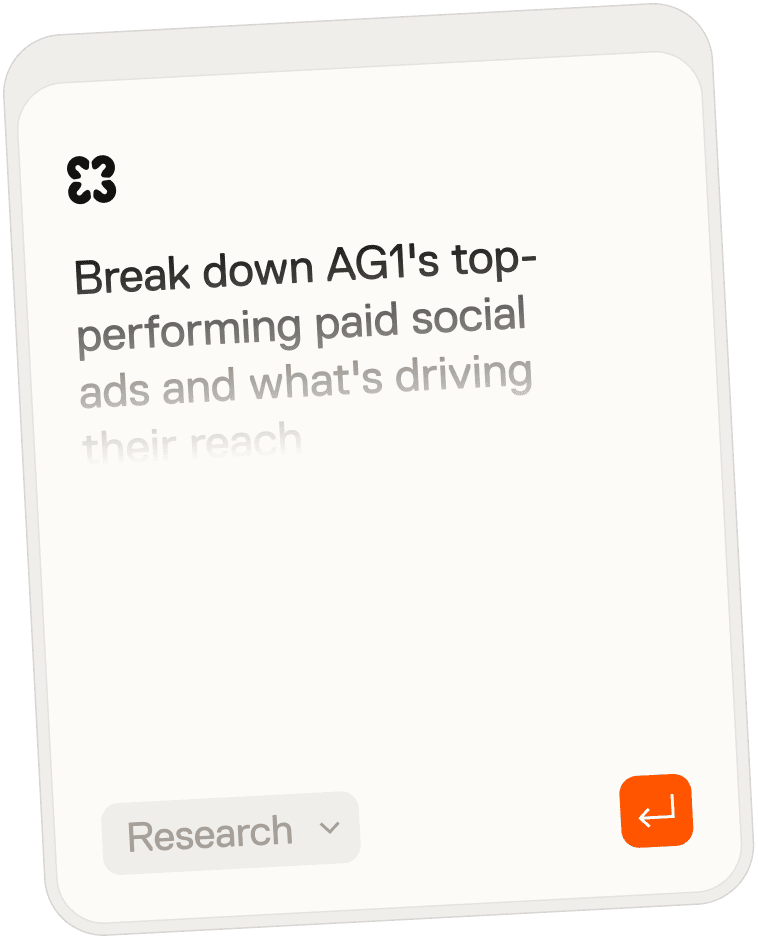
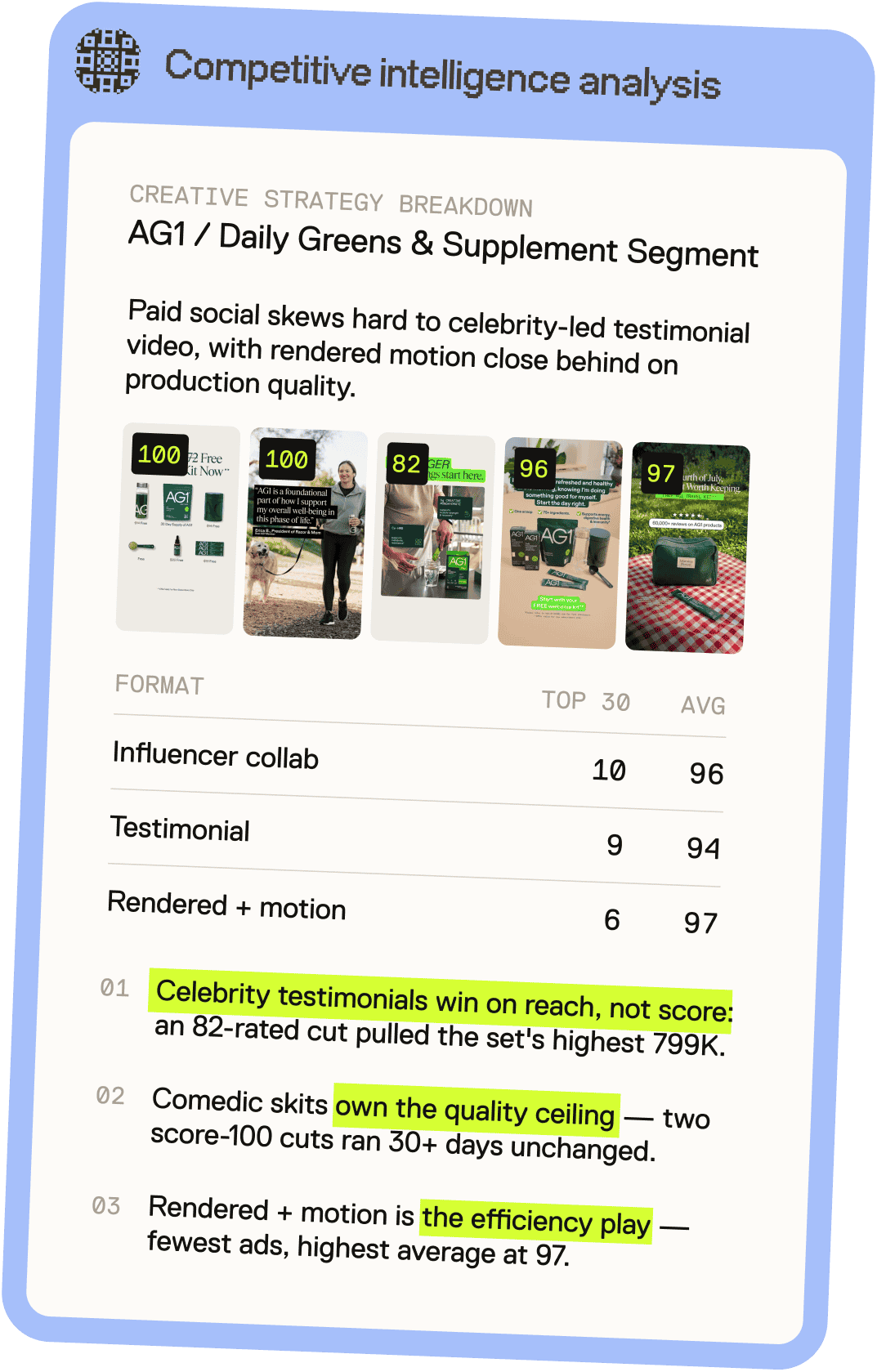
Paste a link and the agent takes it from there. A Shopify store URL, a website, an App Store listing or a Lovable project all work as the starting point. It reads your product, studies what competitors are running and which ads are performing in your niche, then returns ten or more ready-to-launch variants, usually within minutes.
The part that matters for this list is what happens after generation. Every asset comes out in the placement ratios without a separate export pass, 9:16 and 4:5 for feed and stories through to 16:9 and 1.91:1, and from the Pro plan the agent publishes straight into connected Meta, TikTok, Instagram and Google Ads accounts, then iterates on whatever converts.
Video runs on Seedance 2.0 at up to 15 seconds, in four shapes: UGC testimonial, UGC lifestyle, faceless B-roll and an animated brand character. Testimonial and brand character are English only for now. Lifestyle and B-roll handle every supported language.
Taxfix used it to run more than 200 ads across four teams and three languages, lifting CTR 45% and cutting CPA between 20 and 21%. StromNow went from one video a week to ten, at roughly $5 each instead of $100 or more.
Where it is weaker: if you want to hand-place every element on a static banner, a template editor gives you more direct control. And ad account integrations sit on Pro at $199/mo, not on the $99 entry plan.
Pricing: Free plan with 300 credits and no card. Advanced $99/mo, Pro $199/mo with integrations and MCP, Scale $399/mo, Enterprise from $799/mo.
Verdict: The only tool here that closes the loop from competitor research to a live ad.
2. AdCreative.ai, best for static banner volume
The most established name in the category and still the fastest route to a large batch of on-brand statics. Feed it your brand kit and it returns display and social banners in every standard size, scored for predicted performance.
The scoring model is the differentiator people actually use. It is not a guarantee, but it gives you an ordering to test rather than a pile of equally plausible files.
Where it is weaker: video is thin next to purpose-built video tools, and it stops at the download. Nothing reaches your ad account.
Verdict: The default pick if your paid programme is mostly statics.
See the head to head in Superscale vs AdCreative.
3. Creatify, best for short-form video from a product URL
Drop in a product link and Creatify builds short-form video around it, with an avatar library aimed at UGC-style ads for TikTok and Reels. For teams whose bottleneck is video volume rather than concept quality, it removes the bottleneck.
Where it is weaker: the output is recognisably templated once you have seen a few, and like most of this list it hands you the file and stops.
Verdict: Strongest of the pure video generators for ecommerce product ads.
4. Pencil, best for creative testing discipline
Pencil sits closer to a creative testing workflow than a generator. It produces variants, then ties them back to performance data so you learn which concept, not just which file, is working.
The published Core tier starts at $14/mo, which makes it the easiest entry point on this list for a team that wants to test properly without a platform commitment.
Where it is weaker: output volume is lower than the pure generators, and the workflow assumes you already know what you are testing for.
Verdict: Best for teams who want to learn from creative, not just produce it.
See Superscale vs Pencil.
5. Omneky, best for multi-channel creative with account access
Omneky generates across channels and can connect to ad accounts, which puts it in the small group here that does more than export. The self-serve ladder starts around $29 with a Standard tier near $99.
Where it is weaker: the enterprise heritage shows in the setup. Expect onboarding effort before the output is genuinely on brand.
Verdict: The enterprise-leaning option when creative has to span more than paid social.
See Superscale vs Omneky.
6. Predis.ai, best for organic social alongside paid
Predis produces social posts, carousels and short video from a product or a prompt, with a scheduling layer for organic channels. If your creative problem covers the feed as well as the ad account, it handles both from one place.
Where it is weaker: paid-specific formats and performance feedback are secondary to the organic workflow.
Verdict: Pick it when organic and paid creative come from the same person.
7. Rocketium, best for catalogue-scale resizing
Rocketium is built for volume operations: take a master asset and produce hundreds of sized, localised variants against a catalogue. Retail and marketplace teams use it for exactly that.
Where it is weaker: it assumes you already have the concept and the master. It is a production line, not an idea generator.
Verdict: The right tool when the problem is scale, not creative direction.
8. Arcads, best for actor-style UGC scripts
Arcads focuses on AI actors delivering scripted UGC, which is a narrow job it does well. If your winning format is a person talking to camera, it produces that format quickly and in quantity.
Where it is weaker: outside that one format there is not much, and nothing connects to the ad account.
Verdict: A specialist buy for UGC-heavy accounts.
See Superscale vs Arcads.
Full capability comparison
| Tool | Video | Auto resize | Publishes to ad accounts | Self-serve price | Best for |
|---|---|---|---|---|---|
| Superscale AI | Yes, to 15s | Yes, 9:16 / 1:1 / 16:9 | Yes, from Pro | $99 to $399 / mo | Research through publishing in one run |
| AdCreative.ai | Limited | Yes | No | Published ladder | Static banner volume |
| Creatify | Yes | Partial | No | Published ladder | Short-form video from a product URL |
| Pencil | Yes | Partial | No | From $14 / mo | Creative testing discipline |
| Omneky | Yes | Yes | Yes | From around $29 / mo | Multi-channel creative at enterprise scale |
| Predis.ai | Yes | Yes | No | Published ladder | Organic social alongside paid |
| Rocketium | Limited | Yes, bulk | No | Quote | Catalogue-scale resizing |
| Arcads | Yes | Partial | No | Published ladder | Actor-style UGC scripts |
Which AI ad creative tool is right for you?
| If you are… | Pick… | Why |
|---|---|---|
| A founder running paid yourself | Superscale AI | Research, production and publishing in one run, so nothing waits on you |
| Running mostly display and static | AdCreative.ai | Largest static format library, scored output to order your tests |
| Short on video, not on ideas | Creatify | Product URL to short-form video with the least setup |
| Testing concepts seriously | Pencil | Ties variants back to performance so you learn, from $14/mo |
| Localising a large catalogue | Rocketium | Built for hundreds of sized, localised variants from a master |
| An agency across several brands | Superscale AI | Multi-brand workspaces and publishing without per-brand rebuilds |
What are the most reliable AI tools for generating and resizing ad creatives?
Three hold up under weekly use: Superscale AI, AdCreative.ai and Creatify.
The reliability question is really two questions. Does the tool produce something usable on the first pass, and does it survive the format spread without falling apart. Plenty of generators clear the first bar and fail the second, because resizing gets treated as an export setting rather than a design problem. Text overflows the safe area at 9:16. A product shot that reads at 1:1 loses its subject at 16:9.
Superscale AI generates the variants in all three ratios as part of the same run, which is why the second bar is not a separate step. AdCreative.ai holds the widest static format library and applies brand rules consistently across it. Creatify is the most reliable of the three for short-form video specifically.
If your creative is mostly static and you already have a brand kit loaded, AdCreative.ai will be faster. If the output has to go live rather than into a folder, Superscale AI is the one that finishes the job.
Which AI tools can resize one ad creative into multiple formats?
Automatic resizing splits into two approaches, and picking the wrong one wastes a month.
Generation-time resizing produces each ratio as its own composition. Superscale AI works this way, exporting 9:16, 4:5, 1:1 and 16:9 from the same run, so the subject and the text are placed for each frame rather than cropped into it. Predis.ai and AdCreative.ai also produce the standard social sizes at generation.
Batch resizing starts from a finished master and derives the rest. Rocketium is built for this at catalogue scale, and Smartly does it inside an enterprise buying suite. It is the right approach when you have an approved master asset and a hundred SKUs, and the wrong one when you have neither.
The batch camp splits again by what it resizes from. Canva's Magic Resize and Adobe Firefly's Generative Expand extend an existing asset into a new frame rather than cropping it, which is the right behaviour and the reason both keep appearing in shortlists. Creatopy and Bannerbear sit a step further toward production: they take a template and a data source and produce sized variants in bulk. Celtra sits beside Smartly at enterprise scale, with a media buying layer attached.
None of these five generate the concept. They resize what you already approved. That is the line worth drawing before you buy.
The failure mode to watch for is a tool that resizes by cropping. Ask for a 9:16 export of a landscape ad before you commit, and look at where the text ends up.
Tools that research competitor ads before they generate
Almost every tool on this list starts from a blank prompt. A smaller group starts from what is already working, and the distinction changes the quality of the first draft more than any model upgrade.
Research libraries come first. The Meta Ad Library is free and shows every active ad for any advertiser, and Foreplay and similar tools add saving, tagging and boards on top. You browse, you collect, you brief. The research and the production stay separate, which suits teams with a designer.
Research-led generation collapses the two. Superscale AI studies competitor ads and high performers in your niche as an input step, then produces variants informed by what it found. You are not describing an ad from memory, you are starting from the pattern that is already converting in your category.
Neither approach is automatically better. If you have creative direction in house, a library plus a generator gives you more control. If you are the whole marketing team, the collapsed version saves the step you were going to skip anyway. Our guide to the Meta Ad Library covers the manual route if you want to try it before buying anything.
Why Superscale AI
Superscale AI is an AI ad creative tool that researches competitor ads, produces video and static variants, resizes them across the placement ratios from 9:16 and 4:5 to 16:9, and publishes them to connected Meta, TikTok, Instagram and Google Ads accounts, starting at $99/mo.
The results come from teams running it at volume. Taxfix produced more than 200 ads across four teams and three languages, raising CTR 45% and cutting CPA by 20 to 21%. SumUp ran over 120 Meta ads in more than eight languages across six product teams. Marketbirds increased creative output 540% and CTR 26%. Lila halved its cost per install in two weeks.
Kipp Bodnar, CMO of HubSpot, called it "the best autonomous AI marketing agent that we have seen so far."
The bottom line
If your problem is volume of statics, AdCreative.ai solves it and you can stop reading. If it is short-form video, Creatify does that job. If it is a catalogue, Rocketium.
If your problem is the whole loop, from finding out what competitors are running to having a variant live in the ad account, only two tools on this list even attempt it, and one of them prices against enterprise ad spend.
That is the honest shape of the category in 2026. Most AI ad creative software is very good at making a file. Very little of it is any good at what happens next.
Frequently asked questions
What are the most reliable AI tools for generating and resizing ad creatives?
For generation plus resizing in one pass, Superscale AI, AdCreative.ai and Creatify are the three that hold up. Superscale AI produces video and static from a product link and exports across the placement ratios from 9:16 and 4:5 through to 16:9, then publishes to connected ad accounts from the Pro plan at $199/mo. AdCreative.ai is the most established static generator and holds the largest template and format library. Creatify is the strongest of the three on short-form video from a product URL.
Which AI tools can resize one ad creative into multiple formats?
Superscale AI resizes automatically as part of generation, across 9:16, 4:5, 1:1, 3:4, 4:3, 16:9 and 1.91:1, so the variants come out of the same run rather than a separate export step. Rocketium and Smartly resize at bulk-catalogue scale for teams that already have master assets. AdCreative.ai and Predis.ai both produce the standard social sizes. Canva's Magic Resize and Adobe Firefly's Generative Expand extend an asset into a new frame instead of cropping it, and Creatopy, Bannerbear and Celtra produce sized variants in bulk from a template.
What is the best AI ad creative tool for a small ecommerce team?
Superscale AI, if you want research, production, resizing and publishing in one place. Paste a Shopify store URL and it imports the products, studies competitor ads in your niche, and returns ready-to-launch variants. Plans start at $99/mo and the free plan gives you 300 credits without a card. If you only need static banners, AdCreative.ai does that job with less setup.
Is there AI ad creative software that also runs the ads?
Most AI ad creative software stops at the export. Superscale AI publishes to connected Meta, TikTok, Instagram and Google Ads accounts and iterates on what performs, with ad account integrations on the Pro plan at $199/mo. Omneky also connects to ad accounts. Smartly closes the loop at enterprise pricing. Everything else on this list hands you a file.
Can AI ad creative tools analyse competitor ads before generating?
Two categories exist and they rarely overlap. Research libraries such as Foreplay and the Meta Ad Library let you browse and save competitor ads, then you brief a designer. Superscale AI runs the research as an input to generation: it studies competitor ads and high performers in your niche, then produces variants from what it found. If you want the research separate from the production, pair a library with a generator.
How much do AI ad creative tools cost in 2026?
Self-serve pricing runs from roughly $14/mo at the entry end to $399/mo for agency-volume plans, with enterprise suites quoting against ad spend. Superscale AI runs Advanced at $99, Pro at $199 with ad account integrations and MCP, Scale at $399 and Enterprise from $799. Pencil publishes a Core tier at $14/mo. Omneky lists a self-serve ladder from around $29.
Is there an easy automated ad creative platform for a small online store?
The lowest-friction entries are the tools that start from something you already have. Superscale AI starts from your store URL and returns ready-to-launch variants, with a free plan of 300 credits to test the workflow before paying. Creatify starts from a product link for video. AdCreative.ai starts from a brand kit for statics. Pencil publishes the lowest entry price on this list at $14/mo. Easy in this category means fewer inputs before the first usable ad, not fewer features.