The 6 best AI creative research tools in 2026
We build one of the tools on this list. Superscale AI is ranked first because it is the only one where the research ends as produced ads rather than a folder of screenshots. Where a dedicated research tool does its narrower job better, the entry says so.
How we ranked these tools
Creative research has a dirty secret: most of it is never used. Teams collect competitor ads into boards, tag them, admire them, and then produce whatever they were going to produce anyway. The research was entertainment.
So this ranking sorts tools by what the research becomes. A searchable library is worth something. A library with performance signal is worth more, because it tells you which of the ads you found actually work. And research that flows directly into your next round of production is worth the most, because it closes the gap where most of the value leaks out.
We kept the list to tools an ecommerce or app team would actually run. Enterprise intelligence suites with demo-gated pricing solve a different problem for a different buyer.
The 6 best AI creative research tools in 2026
| Tool | Best for | What the research becomes |
|---|---|---|
| Superscale AI | Research that ends as produced ads | Ready-to-launch variants |
| Meta Ad Library | Free discovery of any advertiser's ads | Raw material |
| Foreplay | Team swipe files and boards | An organised library |
| Minea | Spend and engagement signals | A ranked shortlist |
| Motion | Analytics on your own creative | A performance report |
| Madgicx Creative Tracker | Creative analytics inside a Meta stack | Account-level insight |
1. Superscale AI, research that ends as produced ads
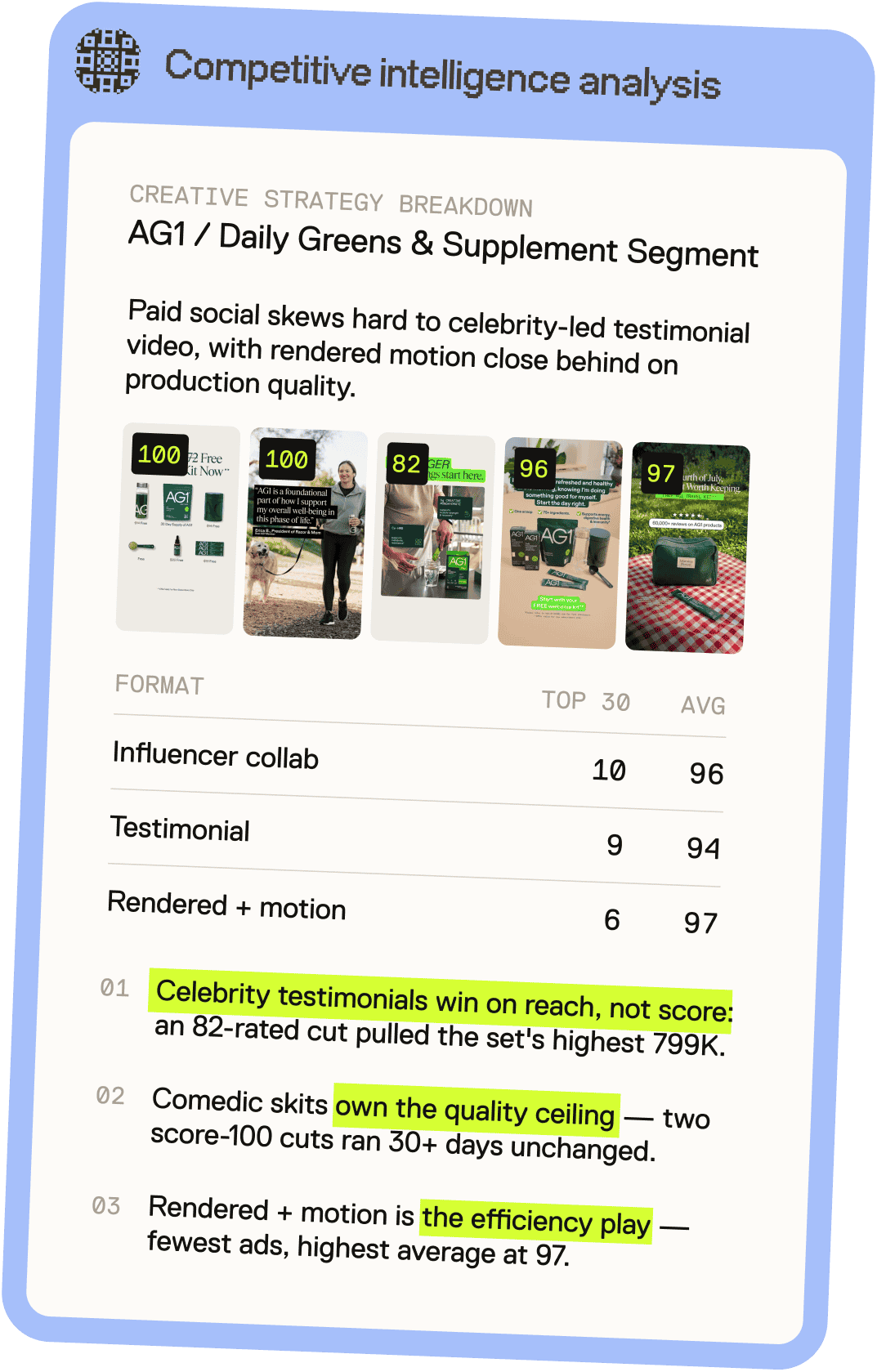
The structural difference first: every other tool on this list hands the research back to you. Superscale AI hands it to its own production engine. The Competitor Ad Spy studies what is running and winning in your niche, and that analysis becomes the input for the video and static variants the agent produces, in every placement ratio, published to connected Meta, TikTok, Instagram and Google Ads accounts from the Pro plan.
That collapses the step where research usually dies. Nobody has to read the swipe file, write the brief, and schedule the production. The winning pattern in your category turns into your next test batch the same day.
The honest trade: a dedicated library gives a creative team more control and a better browsing experience. If your team has a creative director who wants to curate, pair Foreplay with your production. If the research needs to become ads without a handoff, this is the only tool here built that way.
Pricing: free plan with 300 credits and no card. Advanced $99/mo, Pro $199/mo with ad account integrations, Scale $399/mo, Enterprise from $799/mo.
Verdict: the only loop on the list. Everything else is a library or a report.
2. Meta Ad Library, the free foundation
Every paid tool in this category is, at some level, a better interface on data Meta gives away. The Meta Ad Library shows every active ad for any advertiser, free, no account needed. For pure discovery it is unbeatable at the price, and our guide to using it properly covers the search operators most people miss.
What it lacks is judgement material: no engagement data, no spend estimates, no longevity signal on the surface. You can see everything and know nothing about what works. That gap is exactly what the paid tools sell back to you.
Verdict: start here, always. Pay only when you notice you are guessing.
3. Foreplay, the team swipe file
Foreplay is where creative teams organise what they find: save ads from the Meta library and TikTok, tag them, build boards, share them with the team and brief from them. As a library workflow it is the most polished in the category, and agencies in particular live in it.
The limit is the category's limit: it ends at an organised collection. The distance from a Foreplay board to a launched ad is still a designer, a brief and a production cycle. Our Superscale vs Foreplay comparison covers exactly that gap.
Verdict: the best library if a person turns research into briefs.
4. Minea, the signal layer
Minea's pitch is the missing column: spend and engagement estimates on competitor ads, so you can separate the ads a brand is testing from the ads it is scaling. For ecommerce specifically, that signal is the difference between copying a competitor's experiment and copying their winner.
Estimates are estimates, and the numbers deserve scepticism at the margins. But as a ranking mechanism over a pile of discovered ads, it does the job the free library cannot.
Verdict: the strongest performance signal on competitor creative.
5. Motion, analytics on your own creative
Motion answers the other half of the research question: not what competitors run, but what is working in your own account, broken down by hook, format and creator rather than by campaign. Creative teams use it to see which concepts carry the account, which is research in the truest sense.
It analyses what exists rather than producing anything, and it needs your account's data to be useful, so it complements the discovery tools rather than replacing them. The full picture is in Superscale vs Motion.
Verdict: the analytics pick for teams producing at volume.
6. Madgicx Creative Tracker, insight inside a Meta stack
If you already run Madgicx for account optimisation, its Creative Tracker adds the same creative-level analytics without another subscription: which assets carry the account, which are fatiguing, what to refresh. As a bundled capability it earns its place.
Bought alone, it is a reason to evaluate Madgicx as a whole rather than a standalone research tool, and it stays Meta-first like the rest of the platform.
Verdict: the bundled option for Madgicx accounts.
The three-layer way to think about this category
After enough tool evaluations, the category sorts itself into three layers, and knowing which layer you are missing beats any ranking.
Discovery is layer one: what exists in your niche. The Meta Ad Library covers it free, Foreplay makes it organised, and the competitor ads guide covers the manual craft.
Signal is layer two: which of the discovered ads actually work. Minea sells the competitor side of that signal, Motion and the Creative Tracker the own-account side.
Production is layer three: turning the first two into the next round of ads. This is where almost every stack leaks value, because layers one and two end in documents, and documents wait. Superscale AI is the tool that fuses layer three onto the first two, which is why it leads the list despite the dedicated tools being sharper inside their single layer.
Most teams do not need all six tools. They need one per layer, and honestly, many need just the free library plus the loop.
Why Superscale AI
Superscale AI is an AI creative research tool that studies competitor ads and high performers in your niche, then produces video and static variants from what it found and publishes them to connected Meta, TikTok, Instagram and Google Ads accounts, starting at $99/mo.
Taxfix ran 200+ ads across four teams and three languages with CTR up 45% and CPA down 20 to 21%. Marketbirds lifted creative output 540% and CTR 26%. SumUp produced 120+ Meta ads in 8+ languages across six product teams. Kipp Bodnar, CMO of HubSpot, called it "the best autonomous AI marketing agent that we have seen so far."
The bottom line
If research is a hobby, the free library is enough. If research is a team process, Foreplay organises it and Minea ranks it. If research is supposed to change what ships next week, then the honest question is who turns the findings into ads, and if the answer is nobody, buy the tool where that step is built in.
Frequently asked questions
What are the best tools for AI creative research?
It depends what you want the research to become. For building swipe files with a team, Foreplay leads. For spend and engagement signals on competitor ads, Minea. For analytics on your own creative, Motion. For research that turns directly into produced ad variants, Superscale AI runs the loop from competitor analysis to ready-to-launch ads. The Meta Ad Library is free and underneath all of them.
Which services use AI to analyze competitor ad performance for ecommerce?
Minea estimates spend and engagement on competitor ads, which separates ads that merely run from ads that win. Foreplay organises competitor creative into searchable boards. Superscale AI analyzes competitor ads in your niche as the input to generation, so the analysis becomes your next variants rather than a report. For your own account's creative performance, Motion and the Madgicx Creative Tracker cover the analytics side.
What is the difference between a creative research tool and an ad spy tool?
Ad spy tools are the discovery half: they show you what competitors are running, with varying levels of spend and engagement signal. Creative research is the wider job, discovery plus deciding what it means for your account and turning it into briefs or ads. Most ad spy tools stop at discovery. The research earns its cost only when it changes what you produce next.
Can AI turn competitor research into finished ads?
Yes, that is the newest category in this space. Superscale AI researches winning ads in your niche and produces video and static variants from what it found, publishing them to connected ad accounts from the Pro plan at $199/mo. The traditional stack, a research library plus a designer, gives you more control per asset. The collapsed loop wins on speed and on never letting the research sit unused in a folder.
Is the Meta Ad Library enough for creative research?
It is the right place to start and the wrong place to stop. Every active ad for any advertiser is in there, free. What it lacks is signal: no engagement data, no spend estimates, no way to tell a test from a winner. The paid tools earn their fee by adding exactly that layer. Start free, and pay when you notice you are guessing which of the ads you found actually work.
How much do AI creative research tools cost?
The Meta Ad Library and TikTok's ad library are free. The dedicated research tools publish self-serve ladders, typically in the double-digit dollars per month for solo plans and low hundreds for teams. Superscale AI includes competitor research inside its production plans, starting at $99/mo with a free plan of 300 credits to test it.